
St. Bernard Parish Court Records After Arrest
Criminal cases in St. Bernard Parish are handled by the 34th Judicial District Court, which states that it has original jurisdiction over civil and criminal matters in the parish. The arrest starts at the law-enforcement and jail level. The court record begins to take shape after the District Attorney reviews the arrest and decides which charges to file, amend, reduce, or decline.
That difference is central. The St. Bernard Parish inmate records route answers whether someone is in custody. Court records after a jail arrest answer what case was filed, what bond or court dates were set, and whether the charge remained pending, changed, or ended. Booking photos and roster photo limits are separate and belong with St. Bernard Parish jail mugshots.
Search Court Records After Arrest
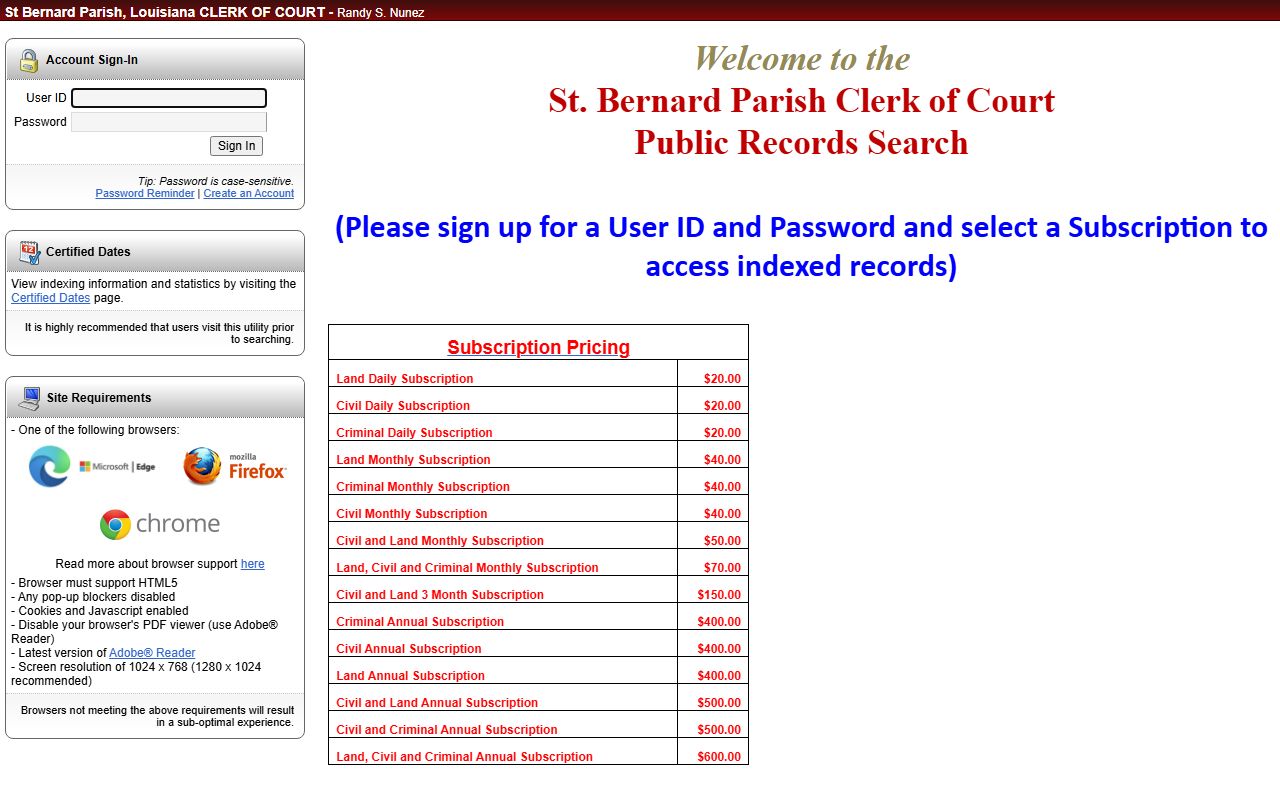
The St. Bernard Parish Clerk records portal is the public-records search portal, but indexed criminal records require a login and subscription. The portal displays User ID and Password fields and states that users must sign up and select a subscription to access indexed records. The portal also lists criminal daily, monthly, and annual subscription prices, plus image and minute print charges.
- Confirm the custody side through the jail roster or Corrections if the arrest is recent.
- Check the Clerk records portal for indexed criminal case records when account access is available.
- Use the District Attorney's public bond and docket pages for near-term bond settings and court dates.
- Compare the filed court charge to the booking charge because they may not match.
- Call or visit the Clerk when the subscription portal does not show the needed case detail.
St. Bernard Parish Court Search Fields
The Clerk portal is account based, so the public landing page documents access fields and fees more clearly than case-result fields. It also gives technical requirements, including an HTML5-capable browser, pop-up blockers disabled, cookies and JavaScript enabled, and PDF viewer settings. For post-arrest research, the main practical point is that the portal is not a free open search for every criminal case.
| Field or Option | Type | Required | Notes |
|---|---|---|---|
| User ID | Text | Yes | Required for portal login. |
| Password | Password | Yes | Portal tip says password is case-sensitive. |
| Subscription | Account/payment | Yes for indexed records | Users must sign up and select a subscription. |
| Criminal daily subscription | Purchase option | Optional | $20 listed on the portal. |
| Criminal monthly subscription | Purchase option | Optional | $40 listed on the portal. |
| Criminal annual subscription | Purchase option | Optional | $400 listed on the portal. |
| Criminal image or minute | Print/view charge | Optional | $1.00 per image or minute record. |
Charges Filed After Arrest
The path is arrest, booking at St. Bernard Parish Prison, initial appearance or magistrate court, prosecutor review, and then court filing. The District Attorney for the 34th Judicial District controls whether charges are filed, changed, reduced, or declined. In Louisiana, a bill of information is a common prosecutor-filed charging document, while an indictment is a grand jury charging document.
| Document | Who Uses It | What It Means |
|---|---|---|
| Complaint | Officer or prosecutor context | Early accusation or charging basis tied to the arrest. |
| Bill of information | District Attorney | Prosecutor-filed charging document used in Louisiana criminal cases. |
| Indictment | Grand jury | Charging document for serious matters after grand jury action. |
Bond Settings After Arrest
The District Attorney's Magistrate Court & Bond Settings page publishes dated magistrate court and bond-setting entries. The research notes examples such as dated magistrate court items by division. A bond setting is a court decision, not a promise by the jail. The jail can confirm custody and may explain posting steps, but bond amount, conditions, and no-bond status come from court action.
| Bond Type | How It Works | Local Note |
|---|---|---|
| Cash bond | Full cash amount paid to the proper authority. | Confirm payment method and hours before arrival. |
| Surety bond | Licensed bail agent posts bond for a fee. | Louisiana permits commercial bail, but no bondsman is endorsed here. |
| Property bond | Real property may secure release if the court permits. | Verify through the Clerk, DA, or court. |
| PR or unsecured bond | Release on promise to appear and comply with conditions. | Set by a judicial officer. |
| No-bond hold | Payment will not cause release. | Can involve warrants, holds, serious charges, or court orders. |
St. Bernard Parish Court Dates
The DA docket and court-date page publishes public-facing court dates by date and division, including division-specific settings and trial weeks. The DA homepage also links magistrate court, bond settings, dockets, and court dates. Those pages are helpful when a newly booked person has not yet produced an easy-to-find Clerk case entry.
The DA also publishes a St. Bernard District Attorney mobile app with advertised features for news, victim information, docket and court calendar, and court contact information. The research does not confirm an app-only court feature, so the website pages remain the main cited public path.
Charge Status in Court Records
Booking charges can change. A person may be arrested on one suspected offense, then see a different filed charge after prosecutor review. A charge can be amended, reduced, dismissed, or declined. Nolle prosequi means the prosecutor declines to proceed on a charge. A court record should be read by current status, not just by the first arrest label.
| Status | What It Means |
|---|---|
| Pending | The charge remains active and has not reached final disposition. |
| Amended | The filed charge was changed after review or motion practice. |
| Reduced | The case proceeds on a lesser charge than first alleged. |
| Dismissed | The court record shows the charge ended without conviction. |
| Nolle prosequi | The prosecutor declined to continue that charge. |
Warrants and Arrest Records
No official searchable St. Bernard active-warrant database was located. The sheriff does publish wanted and arrest-news posts at the SBSO wanted archive, but that archive is not a complete warrant search. Bench warrants may arise in court after a missed appearance. Fugitive warrants, probation holds, parole holds, federal warrants, and immigration detainers may involve other agencies.
If a warrant has been executed and the person is booked, the jail roster may show current custody. If the risk of arrest is real, public-counter searches are not a substitute for attorney advice. Criminal Investigation Bureau, Communications, Criminal Records & Reports, and the court record can each hold part of the picture.
Charges vs Convictions
An arrest and charge are accusations. A conviction is a final result after a plea or finding of guilt. Court records after a jail arrest may show both, but they should not be treated as the same event. This distinction is also why a custody roster can be accurate and still not answer whether someone was convicted.
| Question | Charge | Conviction |
|---|---|---|
| Stage | Accusation after arrest or filing. | Final outcome after plea or verdict. |
| Proof | Based on probable cause or filing decision. | Requires legal admission or proof beyond a reasonable doubt. |
| Can change? | Yes, charges may be amended or dropped. | Changes require later court action. |
Sealed and Expunged Arrest Records
Louisiana Code of Criminal Procedure art. 971 is the research entry point for expungement policy. It does not mean every arrest can be removed from every public or private system. Sealing and expungement are legal processes that depend on case outcome, eligibility, filing steps, and court orders. Juvenile records, victim-sensitive records, investigative records, and expunged records may be restricted even when basic booking information is public.
| Issue | Sealed | Expunged |
|---|---|---|
| Public access | Hidden or restricted from ordinary public view. | Access is limited by an expungement order and state law. |
| Government access | Some agencies may retain access. | Some official access may remain under exceptions. |
| How it happens | Court order or legal restriction. | Eligibility review, filing, and court action. |
St. Bernard Parish Court Sources
The Clerk records portal shows the account-based route for indexed public records and the fee structure for criminal subscriptions and images.
The DA's docket and magistrate pages add public date-by-date case movement, especially around first appearance, bond settings, and division calendars.